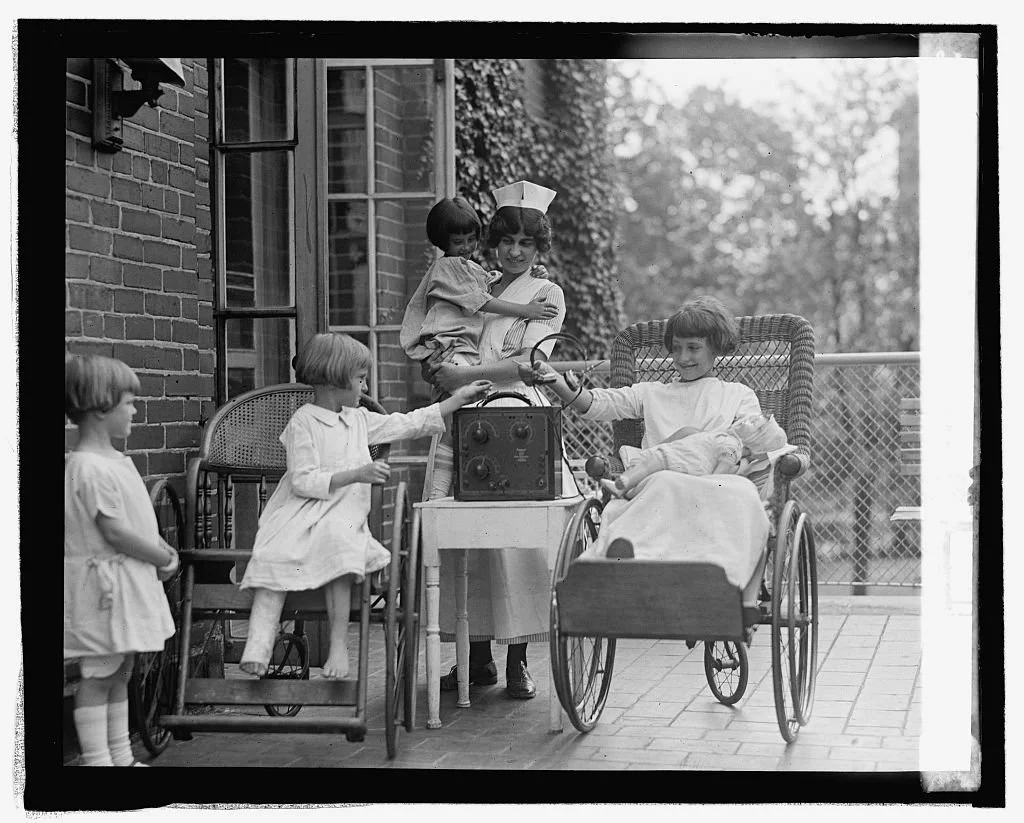
The Children’s Hospital:
Healing America with Pediatric Love
Alert me when The Children’s Hospital is available for pre-order.
COMING SPRING 2027 FROM OXFORD UNIVERSITY PRESS
Pre-order begins early 2027
“soul-stirring”
·
“bold, poignant, and deeply humane”
·
“groundbreaking”
·
“richly researched and movingly told”
·
“a must-read”
·
“innovative and beautifully written”
·
“I was enthralled from the first page”
·
“soul-stirring” · “bold, poignant, and deeply humane” · “groundbreaking” · “richly researched and movingly told” · “a must-read” · “innovative and beautifully written” · “I was enthralled from the first page” ·
“I was enthralled from the first page. In The Children’s Hospital, Liberty Barnes gives us something pediatricians have long felt but never named. Pediatric love is the conviction that every child is worthy of life, opportunity, and someone who believes in them. For those of us who care for children, it is not an abstraction. We live it every day. But it took a brilliant sociologist to see it clearly, put a label on it, and trace its roots through history. This book could not be more timely. At a moment when science itself is under attack and hard-won gains in children’s health are being rolled back, it is a call to defend what we have built. Barnes reminds us of what is at stake and why a society’s care for its children is a measure of its care for everyone. This is an important and essential book.”
— Michael Recht, Professor of Pediatrics, Yale School of Medicine
Advance Praise
“With deep care and extraordinary narrative force, Liberty Barnes offers a compelling history of childhood, medicine, and the meaning of care. Moving from past to present, from revolutionary thinkers to ordinary patients, from sociological methods to pediatric practice, from historical archives to intimate interviews, Barnes traces the invention of modern childhood alongside the emergence of children's hospitals. In doing so, she reveals how medicine, social inequality, and the very idea of childhood became intimately intertwined. Bold, poignant, and deeply humane, The Children's Hospital makes a powerful case for pediatric love as a moral framework, a clinical practice, and, ultimately, a radical vision for how we might care for children—and for one another.”
— Jim Downs, author of Medicine by the People: How Ordinary People Changed American Healthcare
“In this soul-stirring book, Liberty Barnes brings to life a host of intimately observed characters at the children’s hospital: doctors, staff members, child patients, and their families. She weaves their stories with such sociological insight, alongside deeply researched historical-political context, that we are left understanding not only how the children’s hospital feels and why, but also precisely what many of us are grieving in our late-capitalist societies—a sense of justice, abundance, and sanctity of life in our relations with each other.”
— Zeynep Gurtin, Associate Professor, EGA Institute for Women’s Health, University College London
“That children deserve hospitals all their own seems too obvious to mention, yet we know surprisingly little about why such hospitals arose, how they feel, or what they accomplish in a country where children are deemed priceless, yet healthcare induces sticker shock. Liberty Barnes’s innovative and beautifully written inquiry into the inner workings of an institution is the essential prescription for understanding the triumphs and failings of children’s hospitals.”
— Steven Epstein, author of Inclusion: The Politics of Difference in Medical Research
and The Quest for Sexual Health: How an Elusive Ideal Has Transformed Science, Politics, and Everyday Life
“With rich data and historic records, this book shows how pediatric hospitals are unique institutions in which an ethos of love shapes how healthcare providers imperfectly strive for justice and care for all children. The Children Hospital, Barnes acknowledges, is not free from structural racism, health disparities, or subtle biases that seep into care. However, the love and services they provide, she convincingly argues, serve as radical forms of resistance to the capitalist systems that insist human lives are not all equally valuable. After reading this book, we should all wonder why any of us tolerate being treated in healthcare systems as less deserving of love and justice.”
— Jennifer Reich, author of Calling the Shots: Why Parents Reject Vaccines and Fixing Families: Parents, Power, and the Child Welfare System
“This is a compelling book and a must-read for all interested in the health of our children and the role of the children’s hospital. Barnes seamlessly weaves together history, public health, and social science with deeply intimate ethnographic portraits of the physicians, hospital staff, parents, and children that exist in the milieu of pediatric love.”
— Jill E. Korbin, Lucy Adams Leffingwell Professor Emeritus, Case Western Reserve University
“In this groundbreaking book, Liberty Barnes traces how the modern children’s hospital and pediatric medicine became the institutions we know today. Through a mix of careful historical and ethnographic analysis, Barnes reveals how the promises of contemporary childhood and pediatric medicine play out in relation to legacies of structural racism, dispossession, and health inequity. She shows how physicians, working amid these violent realities, attempt to embody an ethic of pediatric love that strives to recognize the inherent value of all children’s lives.”
— Anthony Gerard Wright, author of Surviving the Children’s Cancer Ward: Faith, Care, and Pediatric Oncology
“History reminds us that the institutions we take for granted were once radical ideas. What would America look like if we treated every human life as worthy of the same tenderness and resources we extend to sick children? In The Children's Hospital, Liberty Barnes traces the remarkable evolution of childhood and pediatric medicine, revealing the reformers, cultural shifts, and moral convictions that transformed how we care for our youngest citizens. Richly researched and movingly told, this book illuminates the extraordinary progress we have made and extends a compelling invitation to reevaluate where we still fall short.”
— Marianne Monson, author of Frontier Grit, The Opera Sisters, and American Grit
“In a work that is as attuned to the humanity of its subjects as it is to the depth of its research, The Children’s Hospital is a moving and significant history of care that is as faithful to the past as it is relevant to the present. Scholars of all fields, and general readers of all subjects, will benefit from reading this book.”
— Benjamin Park, author of American Zion
Hailed as soul-stirring, innovative, and deeply humane, The Children’s Hospital explores the development and culture of America’s most beloved institution.
Based on fieldwork at University Children’s Hospital, sociologist Liberty Barnes takes us behind the scenes, weaving present-day medical dramas with history, science, and health care policy. She offers an in-depth look at the social forces that impact child health and the clinicians who repair broken bones and broken childhoods.
This is the first book to examine the marriage of modern American childhood and modern medicine. From the Progressive Movement of the nineteenth century to the medical breakthroughs of the new millennium, children’s hospitals have evolved to reduce the trauma of hospitalization for kids and preserve the innocence and wonder of childhood. Introducing the concept of pediatric love, Barnes argues that children’s hospitals have become symbols of our shared humanity and America’s moral anchors, welcoming families of all backgrounds and championing every human life. However, the success of children’s hospitals reveals chronological age as an axis of social inequality. Hiding in plain sight, age is as powerful and arbitrary as race, class, and gender in determining who can access health care resources and the quality of care they receive.